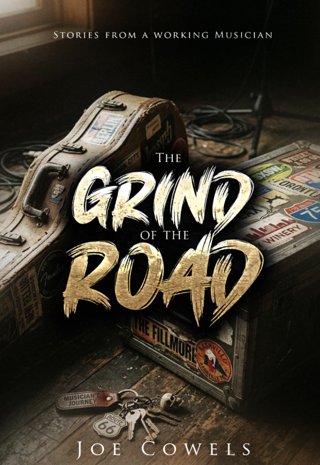
 New book from Joe
The Grind of the Road
Stories from a working musician — now on Amazon.
Get it →
New book from Joe
The Grind of the Road
Stories from a working musician — now on Amazon.
Get it →
Joe Cowels plays over 100 dates a year around Cincinnati — solo gigs, band sessions, subbing whenever someone needs a guitarist — and treats the business side of it with the same seriousness as the playing. Six to eight hours a day chasing bookings, contracts that spell out payment terms, and a hard rule about knowing exactly what a gig is actually worth before he says yes.
We get into what happened when a Nevada venue owner docked his pay and put a pistol on the desk while explaining why, why small claims court is more useful than most musicians think, how a $1,200 AI jingle program started eating into one of his revenue streams, and his advice for anyone starting out: go be the worst player in the room, on purpose.
themoneygigs is supported by Trifloral.com T-R-Y-F L O-R-A-L.com TheMoneyGigs to get your discount, Trifloral produces THC beverages. They come in 2.55 and 10 milligram varieties in all sorts of flavors. I have one prior to my gig and everything is so smooth. Visit T-R-Y-F l O-R-A-L.com themoneygigs that's trifloral.com.
Themoneygigs and get your discount. Joe Cowels is a Cincinnati blues guitarist, over 100 dates a year between solo gigs, his band session work, and subbing in whenever he's needed. He also happens to think about this business more clearly than almost anyone I've talked to. This is the Money Gigs podcast where we talk to working musicians about the real economics of making a living playing music. Today. Venue Horror stories why small claims court is easier than you think how a $1200 AI program cost him gigs and the one piece of advice he'd give a musician just starting out. I want to remind you as you're listening to this episode, you can win a guitar. Go to themoneygigs.comgiveaway to see the contest details. While you're listening to the episode, you can bring up the gigs and venues that you've played and make ratings and comments earning points toward the guitar.
Here's Joe Cowels. Good morning. How are you doing?
Okay.
Good. I don't remember if we've met before, but I see you on Facebook so much it feels like it. And throughout social media and whatnot. So you're really good at marketing. How much of that is you or do you have a team?
I do it all myself, sort of by choice, really. I mean, there's ways nowadays that you can pay people to do stuff pretty cheaply and there's so much AI stuff out there that you can certainly utilize that.
Right.
When it comes to, you know, musicians and the money problem. Right. Oftentimes the musician is his own worst enemy because of the psychology this versus this being a feel good activity. And it's sometimes hard to separate the two.
That's.
That's a real thing. When you said product earlier, that's the perfect word because it is what it is, right? But when you say that some guys get offended and they talk about that's my heart.
It's funny you said the thing about the product because that was the thing with the archburger. When the McDonald's CEO was referring to it as his product, and everybody was up in arms about that. I exist in that space. I get why people were up in arms about referring to food as a product, but that's a corporate realism of it. It is your product. That's an interesting. I appreciate you making that statement, though, because now I know who I'm talking to. That's pretty cool.
It's like horses for courses. When you're talking to a fan, like, yeah, they don't want to hear about the product, but when you're talking to the guy at the venue, he very much does want to hear about the product. He wants to hear about what you're going to do for his business, because at the end of the day, he's looking to keep his lights on, too.
Let's start off with a little baseball card to properly frame this. So, Joe Cowels, for anyone just meeting you. Who is Joe Cowels? Where are you from, and how long have you been doing this?
I was a kid that grew up in the unfashionable land of New York. I started playing in bars and little clubs and stuff in New York at 14 and 15, playing with guys two and three times my age, and that was kind of how I cut my teeth. I started playing a lot of jazz, and what I quickly learned was that you could play 27 chords for, you know, three people, or you could play three chords for a whole lot more people. And one of those paid a whole lot more. It's a bummer, you know, not playing to very many people. And it's a bummer to, you know, go up there and play and pour your heart out into something. And at the end of the day, it's like, wow, I got $12 and I spent $6 getting here and. And. Do you want to eat today? Some part of me will always love that. I don't know that. At least for me, anyways. I don't know that it's a profitable venture. I mean, obviously, there's. There's some guys out there that. That do play jazz and tour and do that stuff. But comparatively speaking, if you took somebody like, say, Scott Henderson, and then you say, okay, well, he tours and he, you know, and he's. And he's successful. What he does. I mean, obviously, the guy stays on the road and he does what he does. Does he make Michael Jackson money or, you know, Taylor Swift money or. Or, you know, I mean, like, no, there's a. You do what you do because you love it. And then there's a certain level of. But a man's gotta eat. And trying to find that happy balance between the two is a thing that will cripple a lot of musicians.
Yes.
In my local scene, I see so many guys that will play a show for 50 bucks. You know, they still have a day job and they played the Room because it's a popular nightclub or whatever. And so it's like, oh man, the room was packed. And we played two, you know, 100 people. And that felt really good. That doesn't pay the bills. You know, there's the part that feels good and there's the part that pays money and the two don't always necessarily meet. And there's also a point where, when you're talking about this as a business, if you're going to do this full time, every now and then I get a little kid that comes up to me and he says, what do I got to do to be a full time musician like you and I, I want to grab him by the shirt, shake him and go be a dentist. There's a thing you have to realize when you make this your job. Right. You know, first of all, you are your own boss. You're like an independent contractor. You are responsible for you. And you don't get to say, well, my boss made a bad decision and it was a slow business day. No, no, you're the boss.
Right?
You're the boss. So you ultimately have to start thinking like a business guy and you have to start thinking about like, I'm selling my product, what is my public image in the market, all these things that are not very, you know, like artistic and are not cool guy sounding, you know.
Well, that's, you know, I went to college for jazz and music and at no point I feel like there were some big muscles that we missed. During the five years I was doing that, I learned a lot about bebop and I played 12 hours a day. And at the time, ibuprofen was the way to go until we got smart about that carpal tunnel, tendonitis, all that stuff. I did all that. But at no point, I think we missed some big muscles. And they happen maybe to be the muscles we sit on. And that would be business related type of things. How do I balance those things and sit on the artistry or support the artistry that I'm trying to do. And I always tell people, you either decide you like to do that and want to do that, or you figure out how to get someone to Represent you and delegate that to someone who can do it and things like that. So, yeah, that's really important. I like what you said about Michael Jackson money as well. Because at no point did someone say to me there's busking and they're selling millions of albums to millions of people. And those seem to be the duality. It seems to be I'm going to play for nothing or I'm going to get discovered and be on TV shows and movies and whatnot. And there's probably a spectrum between those two aspects that will serve you well. But at no point did someone point me at that. At no point did someone create an example a Joe Cowels and say, you could do this. How does that feel? And does that represent the balance that you want? And that I think is hugely missing in sort of the upbringing.
So like, you know, you're saying the hidden spectrum in between and there absolutely is. And yeah, if you went to Berkeley or something, here's some cool guy scales that you're going to use once in your life. And doesn't this sound neat? And then there might be one or two business classes if you choose to take them. And a lot of people like their inner artists just, you know, the hair cackles and they go, I'm not taking that crap. You know my art. Well, you will in fact suffer for your art. There is all those spectrums that are there in the middle and it's doing all the not cool guy stuff.
Yeah.
And they don't necessarily point that stuff out to you. So for example, like my guitar has probably played in your home and you never knew it because it was, you know, part of a commercial.
Oh, wow.
And those things pay money. Right. But nobody, you know, nobody's going to tell you what the local art college or birth rate or whatever. Like they're probably not going to tell you, like, hey, by the way, you can get into making, you know, money, you know, doing the recordings for, you know, whatever dog food commercials or whatever it is.
Right, right.
And they pay you for that. They want some totally soul sucking repetitive poppy thing or whatever that, you know, they're gonna, hey, our dog food is western theme. Play this country sounding thing. But it should be kind of a 30 second repetitive loop. We're just going to talk over like, you know, if you're the artist guy, that's sort of soul crushing. Right, but it's. Right, but that's the thing that pays and it makes money.
Yep.
You were a guy who was a mechanic you might love commerce. So is the job fixing cars? Well, kind of. You're not fixing any cars until people bring you a car, right? So they need to market, right. And advertise to tell people, hey, I'm a guy and I fix cars. And then people say, well, why. Why do I give a crap if you fix cars? Right? So you have to explain to them that there's a reason you want me to fix cars, right? So, yes, you're developing that brand and you're developing that marketing strategy, and you're developing an image, and you got to have a slogan and maybe a logo and all these other things that go into it, right? The next thing you know, it's like, man, I'm juggling 30 hats, right? So, you know, if you wanted to be a successful musician and you. And you come to terms with the idea that, yes, this is a business, right, you have to be that guy, right? So you. Your next thing, you know, like, you're not just a guy that plays guitar, play drums, or play saxophone or whatever, right? You have to be the guy that, like, well, now I know how to build a website. Now I know how to market. Now I know who to advertise. Now I know about learning a branding and learning and imaging. Now I have to learn, you know, how to do taxes at the end of the year. So in my case, at the end of the year, I get 1099, but I send 1099 because the guys in the band are effectively employees. So I have to give them a 1099. They need that to claim as the income. But then I need to be able to write it off.
Write it off, right?
Like, well, I really didn't make $100,000 because I paid this guy 20 and I paid this guy 30 or whatever. You know what I mean?
Like, yes.
As part of that business. So, you know, now you're a tax guy. Like, you are juggling a lot of stuff, and then with all of that stuff going on, you're always looking for that next gig. As a smart business guy, you should never, ever tell anyone. No, the answer is never. No, the answer is that speed is a question of money. How fast do you want to go? Yeah. I would never tell anybody. Like, I'm not going to Banger, Maine to play a show, you know? Yeah. The answer isn't that. It's no. The answer is that I would not go to bangor, Maine for 200 bucks.
Right, right.
For $5,000, we want you here. I'd say, well, suddenly, well, you know, I could Go to banger, man. Right?
Yeah.
[Joe picks up the guitar and plays a few bars.]
Joe, you've had some really interesting experiences out on the road, particularly in Vegas. Do you have any favorite stories from that time about things you may have witnessed?
Yeah, Vegas was kind of a crazy place, you know, and if you haven't been there, you probably can't appreciate how just absolutely sort of insane the whole city can be. It's the kind of place where, you know, the rules and stuff are really more like guidelines than really rules. Because there, the whole city really does live by the motto of, you know, speed's a question of money. How fast do you want to go? Like, almost anything can be bought or traded or sold or gotten if you just wanted to spend enough money on it. So there's lots of crazy, crazy stories that happened, you know, out in Vegas. But, you know, the job thing out there was really tough because, you know, so many guys want those gigs. You know, they were kind of cushy gigs. You play for a casino and they gave you a room. They, you know, did your laundry, they brought your room service for food. I mean, you didn't really. You essentially lived there. You didn't have any bills. And then you walked down and you did, you know, whatever it was, you know, two shows, three shows a day, and that was it. That was all you did. So you had no bills, it paid reasonably well, so it was kind of all profit. And so a lot of these guys, like, just absolutely wasted and squandered, you know, the money that they were making. But, but because it was such a cushy gig, all these guys wanted the one of those gigs. So for every guy that had a gig, there was, you know, 500 guys standing outside, you know, hoping that you tripped and fell to your death because then they could take the gig. And because of that, and there was so many good players waiting to get those gigs. I mean, they could and would fire you over anything and everything. When you, when you played on stage, they used to put Blue Painters tape on the stage and it was about a 2 foot by 2 foot square. And you and your, you know, like your pedals and your amp and all that stuff, you had those, you had to sort of fit it in there in the early days, had to fit in that box. Later on they went to silent stages and there were no amps. And so your amp might be something that goes direct to the PA or maybe it was under the stage or whatever, but you know, you and all your stuff had to fit in this box. And I just, I remember one time playing with a guy and you know, he had just this little five second guitar thing and he thought, oh, I'm gonna step forward and play my little guitar thing and everyone's gonna be wowed by my little guitar solo bit here. And so he did, and he stepped outside of the box and the stage manager was standing there on the side of the stage, you know, behind the curtain. The audience couldn't see him, but he's standing there with his arms folded and just scowling. And the minute that the curtain closed, he like, he walked straight to that guy and basically told him, you know, you and your stuff are fired and you know, get out of my casino and I never want to see you again and you're banned from the site. And they threw him out on his ear, literally. Like had a security walk him out of the place and they had somebody else bring him down his bags because he wasn't even allowed to go get his own bags. They would, they would fire you over anything and everything because it was just so many good players waiting to get that gig behind you.
[Joe picks up the guitar and plays a few bars.]
We've gotten deep into it and I really appreciate it. It's interesting the way you're speaking and people can't see it because this is an audio only on purpose. There will be no video. But you're in a black cowboy hat and a black shirt. But you could easily be in a suit and tie talking to me right now because you're so business cognizant. But I want to make sure to round out sort of the baseball card you have. The Joe Cows Band. How would you describe the Joe Cowells band sound?
What is it?
What's the genre?
So I describe that as blues rock. That's the one thing I'm sort of doing to satisfy my soul, I guess you could say all the stuff that I loved as a guitar player. It's, you know, 60s and 70s booze, rock cream and Clapton and Hendrix and. But then I, I do tend to spin a little bit of some of that other stuff in there, you know. You know, we do a version of Black Magic Woman for example. But towards the end of it, like I'm playing jazz because I. Because I like it. You know, and there's a certain level of, like, this is what I do and this is what I like. Because there's so much of it that I have to do for, like. This is what pays the bill.
Yeah, no, we're. We're very much aligned there. I play solo gigs twice a week. Actually three times this week. And it's a solo keyboard, and I'll play Michael Jackson or the Kinks or whatever, and I'll get the melody out of the way and the key points from the song. If there's a, you know, a horn hit or something, I'll hit that too. But toward the end, I'm jamming, playing jazz. At some point, everything can come back to that if you want it to, and it becomes a unique quality, a nuance to the song that may sell you to people who weren't expecting that. Oh, he didn't just play Born in the usa. He went somewhere else with it. I picked out a simple tune with simple chord progressions, and now I've kind of put my own spin on it. And I think that jazz background helps you find that way.
If you weren't a jazz guy, it would be hard for a lot of people, I think, to really understand this thing. When I grew up playing jazz as a kid, the biggest sin in the world was to play exactly what was on the record. Because the whole thing was. It's like, well, if people wanted to hear the record, then they could stay home and play the record and it would be perfect every time, right? So the whole point of coming to a live performance was that things would change. Maybe you play slightly faster, you play it slightly slower, you play a different. With a different inflection. When you got to the solo part, you know you're. You're going to hit those high points. If that song had a memorable intro where there's a crescendo that it builds to in the middle, like you're going to hit those high points, but everything between A and B is going to be different. Right. And that might be the greatest thing you ever heard, or it could be the biggest train wreck you've ever heard. Right. You would never know if you weren't there.
Right?
So that was the whole reason to come.
Did we really learn all this stuff so that we could sound like the record? And it's that cliche phrase, make it your own, because people come first. My mantra is people process, then product, which means the people come first. And connecting with them, then we can explore what was their journey as a musician. And then Worry about what it sounds like because I think that's where we need to go. We need to focus back on who is the person, where are they coming from and how are we connecting as people. If that is me performing to another person or me talking to you here, I'm just deciding authentic connection is first and foremost. And when you're trying to sound like the record, you're focused entirely on the product, only on the product. And you're hoping that if you sound just like the record, you will connect with people. And you didn't need to do that in the first place. You can go ahead and connect with people and then see what they might want to hear and work it out. So I appreciate that. Your grind reality. 120 Dates a year plus sub gigs, recording fill ins. What does a normal week actually look like for Joe?
I would tell you that so much of the business is not the playing part. And we joke in the band all the time that like the playing parts free, that's the thing we would do anyway, right? It was the hauling the gear and the drive and the setup and the advertising that was the crap that we're charging for. Because that's the part that wasn't fun, right? So my day is spent, I would say six to eight hours every day, emailing, venue, scrolling over, you know, even things like Craigslist or you know, looking at forums on, you know, Facebook and things like that where people are like, oh man, my guitar player has appendix removed and he's going to be out for you know, five days and I need somebody that can fill in and you know, and then you go in and look at the set list and you go, yeah, I know a ton of that stuff. And I might only have to learn, you know, five, six songs or whatever. Like you know, between now and Friday. Like yeah, that's doable. I can do that, right? I spend six, eight hours a day, every day looking at like for example, for most the pay rate is typically 150, 200 bucks a guy. It's a solo thing or not to band thing. And I know that can change area to area. So you know, in my mind I'm factoring that in and I'm going, well for that money, how far am I willing to drive? Kind of cut that off at say an hour and 15, an hour and a half drive. And then in that little radius when I'm looking at a map, it's like I am messaging every club I can find. Once A month. And I might do that for four months, let's say. And if I don't get a plan four months, I usually leave them on. That kind of. Is the answer yes. And then maybe next year, when I start next year's booking, then I might poke them again and say, hey, now I'm booking for 20, 27.
When you were doing this, when you do those emails and you were doing this early on, did you have feelings of rejection? When you would send things out and you wouldn't get responses and you're thinking, these people are so rude. They're not courteous at all. I'm not getting responses. Did you ever have anything like that?
Oh, sure. And that's absolutely. That psychology thing that I was talking about. And it's easy to get down in the dumps about that. And then if you got that, you know, that local bar owner that like, to put it the 180 that, you know, will answer you, and I'm your best buddy in the whole world, and, oh, we're all friends here, and this is a great club and like, and whatever, but. But it pays 50 bucks, right? Fall into the trap of, but we're all friends and it's a fun place and it's the happening place to be. You know what I mean?
Like, yeah, there is an opposite. Yeah.
And, you know, if you played for 50 bucks and you know, and you were trying to do this as a living, now, I guess if you're the guy that plays two gigs a month, I guess, you know, you can do what you want because, again, you're the boss. Right?
Right.
But for those of us that are trying to, you know, like, eat from this and pay the mortgage, like, the definition of optimism, Right. Is musician with a mortgage.
Right.
So if you're trying to do that, like, you can't afford to play five times a week for 50 bucks, man.
Right.
You know, that's. That. That doesn't work. There are times when I have literally looked at gigs and said, well, this guy pays, you know, 200 bucks, or this guy pays 250 bucks, but I gotta drive an hour. And I'm probably planning to, you know, 15 people, and one of them might want to tell me to shut up because they'd rather hear the game. Or I could go play the quarterly cool club, but it's only 50 bucks. And it's like, but I spend, you know, 30 bucks in gas getting there. And it's like, this is not a winning venture. And so you have to make the smart business decision. And not the thing that feels good at the time.
In my primer questions to you said, so many stories about venue experiences. Do you have any that come to mind? We can leave the names out and such to make it respectful and professional, but do you have anything in your pocket that you'd be willing to share?
I played for a guy one time. This was a venue in Nevada where I played. And when I got done, the guy says, we'll come back into my office and we'll go over the numbers. Go over the numbers. What does that mean, Scoob? Like, you know, like, I'm going, that doesn't compute. I thought we had an agreement. And then the other part of me, and maybe this is just my inner New Yorker, it was like, oh, look who wants to get punched in the mouth because you're trying to change the deal. Right?
Right.
So I'm always between, like, concerned and, like, getting really upset.
Right.
The minute I walked in the office, he's sitting at his desk. And I walk in the office, and he's sitting there with a. He's got a notebook in front of him and a pistol right next to it.
Wow.
And I come in, and I'm standing there, and I'm looking at him, and he goes, sit down. And I'm like, oh, okay. And I sit down, and he's looking at the numbers, and he's like, well, and this cost this. And this cost this, and this cost this. And, you know, you guys. You know, you. You beat. No joke. He literally said this. You guys ended three minutes early.
Three minutes early.
Three minutes early. We were supposed to play till 12, and I guess by his clock, we ended at 11:57. In my mind, it's like, well, you know, when I play songs that are five and six minutes long, it's like, well, running over sometimes is a bad idea. People don't like it when you run over.
Sure.
If you're at a place where there's provided sound, the other guy's like, hey, the minute you're 30 seconds over, I'm not getting paid anymore. Like, you know, hey, look, let's go.
Yep.
So, like, running over can be a bad thing. Now if you're playing your local. Your local bar or whatever, like, maybe they don't care, you know, maybe.
Right.
Your show ends at 12, but maybe you can play to 12:30. And they're like, hey, cool.
Free. More.
More free music. Right? But in a lot of. A lot of the clubs, it's. It's. It can be bad to run over So I. I'm sure I was probably at the moment, you know, on my watch, I'm looking at 1157, 1158, and I'm going, I can't put another song in. So. Hey. Yeah. But he literally mentioned that, you know, you ended three minutes early and he's like a signing fine. That. Minus 20 bucks.
Yeah.
And so at the end, it's like, you know, he hands me this money and of course, it's significantly light. And I kind of looking at the money and I'm looking at him, and then I'm looking at the pistol and I'm looking at him and I'm looking at the money and I'm going, sometimes discretion is the better part of that.
Yeah. Did you ever play there again?
Absolutely not.
Good for.
You can choose to not be part of that. Now, 50 bucks or whatever it was, or 75 bucks is probably not worth getting shot over. So, like, I'm gonna. I'm gonna take it and go, okay, have a good one and just not come back, you know? And that's true of lots of things. Whether you're playing band, doing solos, when the guy stiffs you or whatever, sometimes you can have recourse times. It's honestly not worth it. Now, I will tell you, I have taken venues to small claims for, and it's not difficult. Some people seem to think, like, when the guy stiffs you, like, oh, you've got no recourse and you're just. You're just, you know, Sol. That's not true. It's actually relatively easy to take someone to small claims too. Wow. And if they're a business, if you're suing the. The bar or the venue or whatever, well, they can't afford to not show up. If you don't show up, you automatically lose. If I sue Bob's bar and Bob doesn't show up, I can say anything I want. I automatically win. Right. That's not good for Bob.
Right.
Bob shows up. That's when I present my evidence of, here's what we agreed to. And every single time, ultimately, they have always sided with me and said, hey, you know, there's no reason anybody would look at this and think that it shouldn't have been exactly what you put in the email or whatever. And they side with me and the guy happened to pay me because, you know, you don't want liens against your business for, you know, not paying some dude, you know, 600 bucks for his band or whatever. Like, it's not worth it. So when you do that the two things you have to realize is like, okay, this is a process, and it takes a little while. Small claims court in your local municipality is faster than, you know, big stuff. But, I mean, it might take a month or two, but it also means you will never, ever, ever, ever play there again.
Right.
Because now you. Now you have offended him by forcing him to pay you when he didn't want to pay, and it hurt his feelings and, you know, all that kind of stuff. And the other thing that can go wrong with that is so you sued the guy who are his friends. Because sometimes you might discover that club owner is also friends with two other club owners in town.
Right.
And then suddenly, now I can't play those clubs either.
There's that people thing. Yeah.
So if you are okay with that, then sure, you can go ahead and sue. And it's surprisingly easy. Which would lead me to the other thing that I would mention, which is contracts. Right. That's the scary.
A contract. Yeah.
Sounds like a lawyer. Sounds like there's lots of things going on, and I don't speak Latin. Right. When a venue has sent me a contract that, to me, that's the greatest security blanket in the world. They sent me a contract that means, first of all, like, they're worried about getting screwed. And second of all, that means that, like, they're a professional outfit. They have things they're worried about. They want to make a dollar.
Mm.
When they. When they send me a contract, I read it through, and it's usually pretty plain English. None of these guys are Rhodes scholars or anything. I read it through and it's usually like, you know, great, yeah, don't stiff me. And you know, maybe they might have a clause in there about, hey, we pay by check or 1099 and.
Right.
The other places when you play. And you know, when you play Bob's Bar is not going to sign a contract. And you'll. You'll inevitably, at some point in this business, some genius is going to tell you when you. When you get stiff. That's why you got to have a contract. Well, yeah, except for that when you present Bob Farr with a contract, he's going to look at that and go, I'm just not going to have you. Yeah, here's the thing. If you send the guy an email or even, believe it or not, Facebook messages, when you have something where you say, okay, so at the final end of the thing, okay, so I will see you know, Friday, August 1st 8 to 12, you know, 600 bucks for the band, man. That's your evidence right there, right? When you go to small claims court, like it's in black and white. There ain't no way around it, right? When you spell all that out and the guy says matter, you just agree. Yep, all of that stuff looks great, but that's part of that psychology effect too. You know, there's the ACDC song, but it's a long way to the top. And like all of that stuff is true. You get stiffed, you get threatened, you will come out and find your car's been broken into and somebody stole your stuff. All that stuff happened.
Well, it sounds like you've definitely had some interesting experiences. The pistol on the desk is still with me. That's a very good negotiation tactic. Not a lot of choices there. But you said filling the calendar is a daily full time job, and we've talked about that. What's your actual system? How do you track it, manage it, keep it from eating your brain?
I keep copies of everything. And once you started to become that tech guy where, you know, like you're doing 1099 and you're keeping your receipts and you're keeping a logbook of how many miles you drive. And when I stop and fill up my gas tank, I'm going to get my receipt and save it. Right? You just get into that kind of mood. You, you keep every email that you send, you know, you save them so that, you know, like, oh, yeah, I, I talked to that guy 30 days ago or 35 days ago. Yeah, it's probably about time. I sent him another one as an update. And by the time I see that name, say four times, I go, okay, well, that is my answer.
Move on.
I'm not gonna, I'm not gonna ping him again. So I'll wait until, for me, it's October. About October, I start saying it's time to book for next year. That's when I go through first every place I played this year. And I say, hey, I'm booking for next year, you know, and I'm booking, you know, for me, I booked the whole year, I'm booking the whole year. You know, let me know, you know, what you got. And I try to give those people the first digs of things. And then I go back to it. Well, let's message all the places that didn't reply, like, I'm not doing X, Y and Z right now. Hey, I'm booking, you know, next Year, if anything's changed, you know, and then I start looking for the other place. You know, my system is kind of like. So I'm looking at that, you know, say, 150 to 200 bucks a guy kind of thing. And I, and I start saying, okay, for me, that's about say an hour and 15 to an hour and 30 minutes drop. And then I message every place in.
That, you know, Right.
You live in a little town, it's like you probably have two or three bars, right? So how many bars do you think are within, say, an hour and a half of you? And if you live, you know, near any kind of, you know, metropolitan area, it's like, man, that's thousands. So if you think, well, I've messaged every bar in my town, I did it in two days. Like, you just know you haven't. You need to, you know, seriously reconsider that and find other ways to search so that you can spend hours doing that. And I do. And even now that I've been doing this for years, I still discover like, oh, you know, I'll see some other band post about it or something. I'll say, oh, I didn't even know that place existed. And they have music. And I start messaging that this place. Then there is where I start saying, okay, if I feel like maybe I've run into a wall, okay, I've searched for an hour and I haven't found anything. Right. Now let's change gears. I've got these dates I haven't booked. Maybe say in the next two weeks, likelihood of picking up a gig, I'm not gonna say it's impossible. But the likelihood of picking up that gig in the next, say, two weeks is pretty slim, you know, unless somebody says, hey, so and so canceled on me, are you available?
Right, right.
You're probably not going to fill it. So then I start looking for those, hey, my guitarist is out sick. Hey, my bassist is out sick. Who could step in and fill this? And I start looking for those subjects. Then after that we start looking for. So, for example, no one is probably paying you to play music Monday at 8 o' clock in the morning, right? So I would never say never, man.
Breakfast gig.
Sure, I've played grocery stores. Yeah. In my, in my area. I don't know about yours in my area, though. There's a grocery chain here called Kroger.
Yeah.
And, and this is so back to that psychology thing. This is one of those gigs that the I'm an artist guy will thumb their nose at because they're like, you know, whatever, playing on the corner or playing next to the Starbucks or something. And people just walk on by you and nobody claps or whatever.
Yeah. There's Edna with her basket and she's got the big brick of toilet paper as you're going, as she's going by and you're trying to play something poignant, you know, love those moments.
And that can be a little soul crushing. And for, you know, the feel good guys, it's like, this doesn't feel good. I don't want it. But that's the gig that might pay 250 bucks to play two hours, right. And that's something you can do on a Monday from you know, say 10 to noon or something, or noon to 2. And it's like, no other place is paying you to play music during those times.
Yep.
And if you could pick up, you know, if you went to say three different Krogers and you had two gigs in each of them, now you've got six gigs paying you say 200 bucks, 250 bucks a go. You just made a thousand dollars.
Yeah.
And you haven't even touched your Fridays or Saturday nights or even a Sunday afternoon playing at the brewery or anything like that.
That's right.
So how do you get paid? Like stop worrying about what feels good. Psychology thing can go into that too. Because if you're the guy that says, well, I only played country music or I only play whatever, right. And so you're playing that and the people aren't digging it, you're like, man, this is the bum, you know what I mean? And when the guy comes and tells you like, hey, you know, you're blasting these folks out, like, you know what he's really telling you is read the room and, but you know, you wanted to, you're playing whatever you're playing quiet riot and quietly. It's got to be loud. So yeah, but you're playing in a restaurant, you're blasting the 80 year old people sitting in front of you like, and they don't even know what this is that you're playing.
Right.
But you know, that stuff doesn't feel good. And then you think, well, I don't want to go back there. But man, if that was the gig that paid 250 bucks, man, I'd want to play there every week if they let me.
Yeah. I think it's a valuable question to take with you as a musician into any circumstance, really any circumstance at any time is what Can I learn from this? That that's the thing that I was missing probably in my 20s, certainly it dissipated in my 30s, but it's taken well into my 50s now to get to the point where I'm like really observant. My philosophy with a lot of things is Texas Holden poker. When you're dealt the two cards, you're not in control of that. The three on the table, you're not in control of that. And what comes next, you're not in control of, but you are in control of do I play this game or do I fold? And then thereafter, how do I play this game? And I think that for me is the situation of a gig being presented to you or you being delivered to a gig situation. What am I in control of? Do I want to play this game and if so, go all in and.
Having the skill set to play that game?
Yeah, yeah.
You know, I, you know, I'm in love with the blues rock stuff and I, you know, and I do love, you know, some jazz stuff, but like, you know, maybe having two or three country songs in your back pocket, you know, you don't have to be madly in love with them, you just have to be able to play with them and they have to be something that's a reasonably popular song because you're going to get that guy that goes, hey, you know, any country. And you look around, you start reading the room and you go, this is that place.
Right?
And I don't know that they care about, you know, the intricacies of green sleeves or, you know what I mean? Like, maybe I'd better play Tennessee Whiskey.
Yeah.
You know, so having that kind of stuff, you know, you can be the whatever guy, but like, maybe I better know a couple pop songs and a couple country songs and.
Yep.
And that stuff's going to benefit you again when you're back to juggling hats.
Yes.
There's a lot of other jobs. So for example, like I said, you know, I, I go to search my solo gigs, I go search my band gig, then I'm looking for those sub gigs, you know, then I'm looking for, you know, any of those like day type can I pick up day times that, you know, at a Kroger, at a coffee house, at a brew house, at any of that kind of stuff. Yeah, I'm looking for recording gigs because that stuff I can do in my underwear at 2 o' clock in the morning. They don't care when I do it as long as I Get to them by a certain deadline.
Yeah.
Looking for those recording gigs, then the other thing to look for is teaching. And this is one of those things where people leave money on the table and you have to have a certain mentality, you know, to teach somebody.
Sure.
You know, all this stuff and they don't. And you get, it's easy to get frustrated when you're trying to show somebody something and you're like, damn it, no, it like this. Right. But they don't know that, man. They're new. So you do have to have a certain mentality. But when no one is paying you to play on Tuesday or Thursday, you know, morning, between the hours of, say 8am and 3pm, you could be teaching. And if you taught somebody and you charge, you know, 50 bucks a lesson for a 30 minute lesson or 45 minute lesson or whatever, and maybe you can line up three of those on a Tuesday and three of those on Thursday, it's like, well, that's another 300 bucks. Being able to juggle all those hats. Not just standing on stage and making some cool rock guitar guy, you know, I'm guitar God. Faces like, you know, we love to do that when we can get away with it, right?
Sure.
Being able to do all the not cool guy stuff, you know, being able to do. Somebody mails you tracks and says, hey, I just, I'm not a guitar player. But this song kind of calls for a guitar solo. Everything else on here is keyboard. Can you, can you put a guitar solo on this? You know, pay me and I'll be there playing those daytime gigs that, you know, they may be wine bars, they may be coffee houses, they may be breweries, they might at the grocery store, they make whatever even to the point of busting. If you were trying to do this full time. I have told people, if I was starting today and I had no brand, I had no image. It's a process and you have to build a website and all that kind of stuff. But between here and there, man's got to eat. You got to like, you know, maybe pay the rent and not get thrown out in the street, right?
Yep.
If I couldn't find somebody that would pay me, I would probably drive up to the nearest sports bar and I would walk in with a small PA and like an acoustic electric guitar. And I would walk in and I would say, hey, look, I don't know, you normally don't probably do this, right. But if you would let me, I would set up over here in the corner. And I would play for, you know, maybe two, maybe three hours. I'll keep it at a respectful volume so the patrons can still talk or whatever.
Right.
I'm not blasting anybody out and I'm literally happy just to just play here for tips and happy to see when, if I was starting out, that's something that gets you seen. And at that point, if you made say 60 bucks in tips, 60 bucks is better than no.
Right. It's product market fit too. It kind of verifies that you're appreciated. You're not running anybody out of the room. You're actually being appreciated monetarily. That's some validation. You've covered a lot of things and something came to mind as you were talking about what everybody's doing with music and the different ways venues are using AI to book fans are using AI to discover music. We've got AI all over the place with different types of music. And it's encouraging to me that you're being asked to record things still and we still have that opportunity in this new landscape. I'm curious how that's how AI is like encroached upon your game at all and what your disposition is with it.
I mean, it can be a great marketing tool. But I will tell you, I have lost AI because there is programs now that companies can buy that will basically write a jingle for you. And when you're writing, it's not complex. And these companies have come to me and said, hey, we're not going to do this anymore, the twelve hundred dollar program. And it's going to, you know, it'll write a jingle for me every five minutes if I want. So I have lost some gigs and I will say I'm doing less of that now than I did say 10 years ago. My false economy moment with those people is like, well, but it's like a computer, right? You bought a twelve hundred dollar program and unless you're going to write a million jingles this year, you know that next year that program's going to be out of date.
Right.
Ask you to buy another $1,200 program.
Right.
Whereas me, I'm always up to date.
That's right. That's right. I think so, yeah. It's an interesting. I'm not necessarily threatened by it. Again, I call it cards on the table in the Texas Holden poker analogy, but it's just cards on the table. I'm not necessarily threatened by it because I do think there's going to be a return to analog people. I just bought actually a CD player with a cassette tape player on it.
From student A CD that night. I still have CD.
Yeah, which we're talking about CDs like It's Ancient too. And that blows my mind as well. You kind of stole my last question, which was if you could tell a musician who's just starting to gig seriously like 30 dates a year and wants to get where you are, what's one thing you would tell them that nobody tells them? You did give a good playbook there for going into a bar to kind of get an opportunity. And actually that's actually what I did to get my current opportunities. I looked at restaurants that did not have live music and went in and one of them was owned by a friend of mine. And so that resulted in a 2 dates a week residency. So it's like a 10 minute phone call turned into 17k for the year. But what would you tell people starting out that nobody tells them always aim.
To be the worst musician in the room because you're going to learn things from people that are better than you.
Definitely. I want to mention the joecowlsband.com website where you can go see everything that is going on with Joe Cowels. Really appreciate it.
Huge thanks to Joe Cowels for the time and for being honest about the parts of this business that don't feel like rock and roll. Go check him out@joecowlsband.com link is in the show notes. One more thing and this one's a fun one. Joe didn't just give us his time for this episode. He hand built a guitar, a plum crazy purple Strat style build, custom noiseless pickups, bone nut, hard shell case, the whole thing. And he's giving it away to one listener. Here's how you get Download themoneygigs app, use the code INV JCWLS and you're entered. Rate a venue, send in a gig, screenshot, refer a friend. All of that adds entries. Full rules are@themoneygigs.com giveaway links in the description. That's it for this one. Same time, next episode. Until then, know your worth and I'll see you out there.
Joe Cowels is a Cincinnati blues guitarist and bandleader playing over 100 dates a year between solo gigs, band sessions, and subbing in whenever he's needed. He runs the business side — contracts, 1099s, bookkeeping, six to eight hours a day of outreach — with the same discipline he brings to playing. Find him at joecowlsband.com.
The podcast is free and always will be. Subscribers get at least one extra episode every month.
♫ Subscribe to unlock bonus episodes!MoneyGigs is the app for working musicians — track pay, review venues, and see your true hourly rate. Free on iOS and Android.